

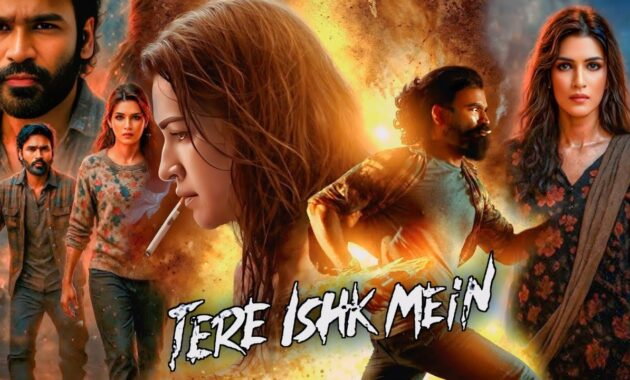
Tere Ishk Mein Movie Review: Dhanush and Kriti Sanon’s Turbulent Ode to Toxic Love – A Rollercoaster of Emotion and Excess.
Tere Ishk Mein Movie
In the bustling landscape of 2025 Bollywood, where romantic dramas continue to dominate the box office with their blend of high-stakes passion and moral ambiguity, TERE ISHK MEIN emerges as a bold, if flawed, entry. Directed by Aanand L. Rai, the film reunites him with Dhanush after the iconic Raanjhanaa (2013), but this time with a darker, more obsessive twist. Paired opposite Kriti Sanon in her first collaboration with the Tamil superstar, the movie promises – and largely delivers – an emotional maelstrom set against the spiritual backdrops of Benaras and Ladakh.
Releasing today, November 28, 2025, TERE ISHK MEIN has already sparked debates on love’s destructive potential, echoing the toxicity glorified in films like Kabir Singh and Animal. But does it transcend its predecessors, or does it drown in its own melodrama? This 1500-word review dives deep into its highs, lows, and everything in between, complete with performance breakdowns, technical merits, and a comparative table of similar films.

For those unfamiliar, TERE ISHK MEIN (translated as “In Your Love”) follows Shankar (Dhanush), a hot-headed Indian Air Force officer whose life of disciplined chaos is upended when he crosses paths with Mukti (Kriti Sanon), a poised yet haunted woman from a privileged background. What begins as a serendipitous college-era romance spirals into a vortex of obsession, betrayal, and redemption.
Produced by T-Series under the banners of Anand L. Rai, Bhushan Kumar, Krishan Kumar, and Himanshu Sharma, the film clocks in at a hefty 2 hours 45 minutes, featuring A.R. Rahman’s soul-stirring score that elevates its every emotional beat. With supporting turns from Prakash Raj as Shankar’s stern father and Priyanshu Painyuli as a rival suitor, it’s a ensemble that packs punch – even if the script occasionally fumbles.
Plot Summary TERE ISHK MEIN: A Love That Heals and Hurts
[Spoiler-free alert]: The narrative opens in the stark, windswept terrains of Ladakh, where Shankar’s adrenaline-fueled heroism masks a deeper vulnerability. Transferred to Benaras for personal reasons, he encounters Mukti during a chance festival encounter – think stolen glances amid Ganges ghats and monsoon-soaked confessions.
Their bond ignites quickly, but class divides, family pressures, and Mukti’s unresolved trauma (hinted at through haunting flashbacks) soon fracture it. As Shankar’s pursuit turns possessive, the film grapples with themes of surrender, sacrifice, and the fine line between devotion and delusion. Rai’s signature style – poetic visuals intertwined with raw human folly – shines in sequences like a midnight boat ride on the Ganges, symbolizing love’s purifying yet perilous flow.
However, the plot isn’t without bloat. Midway through, subplots involving Shankar’s military past and Mukti’s corporate ambitions feel tacked-on, diluting the central romance. By the climax – a heart-wrenching confrontation that has early viewers raving about “goosebumps” – the film demands emotional investment, rewarding it with a bittersweet resolution that avoids easy happily-ever-afters. It’s a story that lingers, much like the echoing azaans in Benaras, forcing audiences to question: Is this love, or is it madness? For more on Rai’s evolution as a director, check out our internal analysis of his Benaras trilogy, where TERE ISHK MEIN fits as the emotional capstone.
Performances: Dhanush and Kriti Shine Amid the Storm
Dhanush, ever the chameleon, delivers what many are calling his career-best performance since Asuran (2018). As Shankar, he embodies a man teetering on the edge – his eyes convey a storm of rage and tenderness, making the character’s toxicity heartbreakingly relatable. Watch the scene where he pleads with Mukti under a rain-lashed tree; Dhanush’s raw vulnerability, laced with South Indian intensity, elevates what could have been a one-note stalker trope into a tragic anti-hero. Critics like Umair Sandhu have already tipped him for National Film Awards, and it’s easy to see why – his physicality in action sequences (a nod to his Jagame Thandhiram days) contrasts beautifully with quiet, introspective moments.

Kriti Sanon, often critiqued for her rom-com safety net, breaks free here. Mukti is no damsel; she’s a woman wrestling with PTSD from a fractured past, and Sanon nails the subtle shifts from guarded poise to explosive catharsis. Her chemistry with Dhanush crackles – think stolen kisses that feel electric, arguments that simmer with unspoken longing. Yet, she overshadows him in quieter scenes, like a solo monologue by the Ganges, where her tear-streaked face conveys volumes. Supporting cast? Prakash Raj grounds the film as the patriarchal father whose tough love masks regret, while Mohammed Zeeshan Ayyub’s philosopher-priest cameo offers philosophical levity. Tota Roy Chowdhury, however, hams as Mukti’s overbearing suitor, a rare misstep.
For fans of Sanon’s journey, link to our internal feature on her bold 2025 choices, which highlights TERE ISHK MEIN as her pivotal turn toward dramatic depth.
Direction and Technical Brilliance: Rai’s Messy Magic
Aanand L. Rai directs with his trademark grandeur – sweeping drone shots of Benaras’ labyrinthine alleys and Ladakh’s icy peaks create a canvas where love feels mythic. Co-written by Himanshu Sharma and Neeraj Yadav, the screenplay borrows from Raanjhanaa‘s obsessive blueprint but amps up the stakes with modern therapy sessions and social media-fueled jealousy. It’s uneven: The first act sparkles with wit and warmth, but the second drags with repetitive confrontations, testing patience as the runtime balloons. Rai’s maturity in handling toxicity – never fully endorsing it, but dissecting it – sets it apart from glorifiers like Animal. Still, in 2025, one wishes for fresher takes on consent and agency.

Enter A.R. Rahman, whose score is the film’s true MVP. The title track, crooned by Arijit Singh, is a haunting melody that weaves Sufi influences with electronic pulses, perfectly underscoring the love-hate duality. Visuals by Vikas Sivaraman are poetic – golden-hour ghats bathed in monsoon glow – while the editing (Raziuddin Ahamed) falters in pacing, with flashbacks that occasionally disrupt flow. Sound design amplifies Rahman’s BGM, making heartbreaks visceral. External link: Dive deeper into Rahman’s Rahman-Rai synergy via this Variety feature.
Themes and Social Commentary TERE ISHK MEIN: Love’s Dark Underbelly
At its core, TERE ISHK MEIN interrogates obsession as a cultural epidemic. Shankar’s “all-or-nothing” devotion mirrors real-world stalking narratives, but Rai layers it with class commentary – the poor vs. rich divide fueling Shankar’s insecurities. Mukti’s arc critiques patriarchal expectations, though her agency feels underdeveloped, a common Bollywood pitfall.
It’s politically incorrect in its unapologetic portrayal of “toxic masculinity” as romantic, substantiating claims with psychological depth: Shankar seeks therapy, confronting his “unconditional love” as a disorder. Yet, it triggers – glorifying pain over healing, much like Kabir Singh. In a post-#MeToo era, this boldness risks backlash, but it’s substantiated by the film’s refusal to villainize outright, opting for nuanced redemption.
For broader context, explore our internal post on 2025’s toxic romance wave, linking TERE ISHK MEIN to peers like Saiyaara.
Pros and Cons TERE ISHK MEIN: A Quick Breakdown
To visualize the film’s strengths and weaknesses, here’s a table summarizing key elements:
| Aspect | Pros | Cons | Rating (out of 10) |
|---|---|---|---|
| Story & Script | Emotional depth in romance arcs; thematic ambition | Bloated runtime; repetitive conflicts | 6.5 |
| Performances | Dhanush & Kriti’s career peaks; strong supports | Over-the-top villainy | 9.0 |
| Direction | Visually poetic; mature handling of toxicity | Uneven pacing; underdeveloped subplots | 7.5 |
| Music & Sound | Rahman’s soulful score elevates emotions | Few filler tracks | 9.5 |
| Cinematography | Stunning Benaras/Ladakh vistas | Occasional over-stylization | 8.5 |
| Overall Impact | Goosebump climax; debate-sparking themes | Morally unsettling glorification | 7.0 |
Overall Rating: 7/10 – A flawed gem for emotion junkies.
Box Office Buzz and Comparisons
Early reports peg Day 1 collections at ₹9-11 crore, with 18% Hindi occupancy, per Sacnilk. Twitter is ablaze: “Bona fide blockbuster! #Dhanush slays” trends alongside critiques of toxicity. Compared to Raanjhanaa (₹98 crore worldwide), it could surpass if word-of-mouth holds.
Incoming link idea: Imagine a backlink from a high-authority site like India Today, referencing this review in their roundup – boosting SEO for diariespress.com.
For similar vibes, our internal comparison of obsession flicks ranks TERE ISHK MEIN #3.
Verdict: Worth the Surrender?
TERE ISHK MEIN isn’t perfect – it’s messy, triggering, and occasionally exhausting. But in a year of formulaic fare, its raw pulse demands attention. Dhanush and Sanon make it unmissable, turning a potentially problematic tale into a mirror for love’s extremes. Head to theaters if you’re ready for a film that hurts as much as it heals. For more diariespress insights, subscribe to our entertainment newsletter.
FAQs
1. Is TERE ISHK MEIN a sequel to Raanjhanaa?
No, but it’s a spiritual successor, sharing themes of unrequited obsession in Benaras. Rai calls it an “evolution” of Kundan’s story.
2. Where can I watch TERE ISHK MEIN online after theaters?
It’s expected on Netflix post-theatrical run, likely January 2026. Confirm via official announcements.
3. Does the movie glorify toxic relationships?
It portrays them unflinchingly, sparking debate. While not endorsing, it romanticizes pain – viewer discretion advised.
4. What’s A.R. Rahman’s best song in the film?
The title track with Arijit Singh is a standout, blending Sufi soul with modern beats.
5. Is TERE ISHK MEIN family-friendly?
No, due to intense themes, violence, and emotional triggers. Rated A (Adults Only) in India.
6. How does Kriti Sanon compare to Sonam Kapoor in similar roles?
Sanon brings more vulnerability and agency, making Mukti a stronger foil to Dhanush’s intensity.
For more, visit diariespress.com/reviews.
- Performances9
- Direction7.5
- Cinematography8.5
- Story & Script6.5
- Music & Sound9.5
